Get More Value From Every Meeting
Introduction
Your monthly bookkeeping meeting should be more than a quick review of reports.
It is an opportunity to understand what is happening financially in your business, identify potential problems, and make better decisions for the months ahead.
Accurate bookkeeping gives you the numbers. Asking the right questions helps you understand what those numbers mean.
The IRS also emphasizes the importance of good business records. According to IRS guidance, good records can help business owners monitor business progress, prepare financial statements, track deductible expenses, prepare tax returns, and support amounts reported on those returns.
Whether you own a restaurant, construction company, professional service business, retail store, or another small business, here are five questions worth asking your bookkeeper every month.
1. How Did We Perform This Month?
Start with the big picture.
Ask your bookkeeper to walk you through your profit and loss statement, sometimes called an income statement or P&L.
This report generally shows your revenue and expenses over a specific period and helps you see whether the business generated a profit or loss.
The IRS describes an income statement as showing a business’s income and expenses for a given period.
Don’t stop at asking, “Did we make a profit?”
Ask:
- How does this month compare with last month?
- How does it compare with the same month last year?
- Did revenue increase or decrease?
- Which expenses changed significantly?
- Are our margins improving or shrinking?
Example
Suppose your business generated $80,000 in revenue this month compared with $72,000 last month.
At first glance, that sounds great.
But your bookkeeper points out that expenses increased from $55,000 to $68,000.
Revenue increased by $8,000, but expenses increased by $13,000. That means the higher sales did not automatically translate into better profitability.
That is the type of insight you want from a monthly bookkeeping conversation.
Practical Tip
Don’t review revenue alone. Look at revenue, expenses, and profitability together.
A growing business can still experience financial pressure when expenses grow faster than sales.
2. Is Our Cash Position Healthy?
Profit and cash are not the same thing.
A business can report a profit while still struggling to pay bills.
For example, you may have recorded a large amount of revenue from customers who have not paid their invoices yet. Your financial reports may show income, depending on your accounting method, while your bank account tells a different story.
Ask your bookkeeper:
- How much cash do we currently have available?
- Are upcoming bills likely to create cash pressure?
- Are customers taking longer to pay?
- Are there large payments coming up?
- Has our cash balance been trending up or down?
This conversation can help you identify cash-flow problems before they become emergencies.
Example
Imagine your business has $30,000 in outstanding customer invoices.
That sounds promising.
But if you only have $8,000 in the bank and $15,000 of payroll, rent, vendor payments, and other obligations coming due soon, you may have a cash-flow problem even though customers owe you money.
Your bookkeeper can help you see the difference between money earned and cash actually available.
Practical Tip
Ask to review your accounts receivable aging report if you invoice customers.
This report can help identify overdue customer balances and show which invoices may require follow-up.
3. Are There Any Unusual Expenses or Transactions?
Small financial issues are easier to address when you catch them early.
Every month, ask your bookkeeper whether anything unusual appeared in your records.
Examples could include:
- A large expense that did not occur in previous months
- Duplicate transactions
- Unexpected subscription charges
- A vendor payment that seems unusually high
- Transactions that need clarification
- Personal and business transactions that may have been mixed together
- A transaction recorded in the wrong category
Your bookkeeper may need information from you to properly categorize certain transactions.
Why Accurate Records Matter
The IRS states that business owners should use a recordkeeping system that clearly shows income and expenses. Supporting documents such as invoices, receipts, paid bills, deposit records, and canceled checks can support entries in the books and amounts reported on tax returns.
That makes accurate categorization and documentation important throughout the year—not just when tax season arrives.
Example
Suppose your bookkeeping software shows a $4,500 payment to a home improvement store.
Was it:
- Office furniture?
- Materials purchased for a customer project?
- Equipment?
- A repair?
- A personal purchase accidentally made with the business card?
Your bookkeeper should not have to guess.
Providing the receipt and explaining the business purpose can help ensure the transaction is recorded appropriately.
Practical Tip
Set aside a few minutes each month to answer your bookkeeper’s questions about unclear transactions. Don’t allow uncategorized or questionable transactions to accumulate until year-end.
4. Is There Anything I Need to Prepare for Before Next Month?
Good bookkeeping should help you look forward, not only backward.
Ask your bookkeeper about financial items that may require attention over the next several weeks.
Depending on your business, that could include:
- Payroll
- Vendor payments
- Loan payments
- Large recurring expenses
- Upcoming renewals
- Customer invoices
- Sales tax obligations
- Estimated tax discussions with your tax professional
- Planned equipment purchases
- Seasonal changes in revenue or expenses
For businesses with employees, payroll tax responsibilities deserve particular attention. Federal employment tax deposit requirements vary depending on the applicable deposit schedule and type of tax. The IRS explains that employers may be subject to monthly or semiweekly deposit schedules for certain employment taxes, and federal tax deposits generally must be made electronically.
Your bookkeeper can help keep the financial records organized, but questions about tax liability, tax planning, or filing requirements may need to be addressed by your CPA, enrolled agent, or other qualified tax professional.
Example
A Florida business owner notices that sales are strong in November and December but typically decline in January and February.
Instead of waiting until January to discover a cash shortage, the owner can use monthly financial information to plan ahead.
The business may decide to preserve more cash during stronger months, delay a nonessential purchase, or accelerate collection of outstanding invoices.
Practical Tip
End every monthly meeting by asking:
“What should I be financially prepared for over the next 30 to 60 days?”
That simple question can turn bookkeeping into a much more useful management tool.
5. Is There Anything in My Books That Concerns You?
This may be the most valuable question on the list.
Your bookkeeper spends time reviewing transactions, balances, accounts, and financial reports. They may notice patterns that you do not see while managing the daily operations of your business.
Ask directly whether anything looks unusual or deserves your attention.
Possible concerns might include:
- Increasing expenses
- Declining margins
- Growing accounts receivable
- Large outstanding bills
- Frequent owner withdrawals
- Missing documentation
- Unreconciled accounts
- Repeated late customer payments
- Unexpected changes in cash balances
You do not need to understand every accounting detail.
You do need to understand the financial issues that could affect your business.
Example
Suppose your sales have remained relatively stable for six months, but your bank balance keeps falling.
Your bookkeeper may discover that several operating expenses have gradually increased.
Individually, each increase may seem small. Together, they could be putting significant pressure on your cash.
Identifying the trend gives you an opportunity to investigate and make decisions before the situation becomes more difficult.
What Should Your Bookkeeper Review Every Month?
The exact monthly bookkeeping process depends on your business, but a typical review may include items such as:
- Bank and credit card reconciliations
- Profit and loss statement
- Balance sheet
- Accounts receivable
- Accounts payable
- Cash balances
- Expense categories
- Loan balances
- Payroll records, when applicable
- Unusual or uncategorized transactions
Bank reconciliation is an established bookkeeping practice. IRS Publication 583, for example, includes an illustration of reconciling a business checkbook to a bank statement.
The goal is not simply to generate reports. The goal is to make sure your books provide reliable information you can actually use.
How Good Bookkeeping Helps at Tax Time
Monthly bookkeeping can also make tax preparation easier.
The IRS requires businesses to maintain records that substantiate income and expenses reported for tax purposes. The agency notes that a good recordkeeping system can help businesses track deductible expenses, prepare tax returns, and support items reported on those returns.
Record-retention periods vary depending on the type of record and circumstances. For many income-tax records, three years is a common period, but longer periods can apply. Employment tax records generally must be kept for at least four years after the applicable due or payment date.
This is one reason waiting until tax season to organize an entire year’s finances can create unnecessary work.
Consistent bookkeeping throughout the year can make it easier to provide your tax professional with organized financial information.
Get More Value From Every Bookkeeping Meeting
A good bookkeeper does more than enter transactions.
Accurate books can give you a clearer picture of where your business stands. But business owners get more value from those records when they actively review and discuss the numbers.
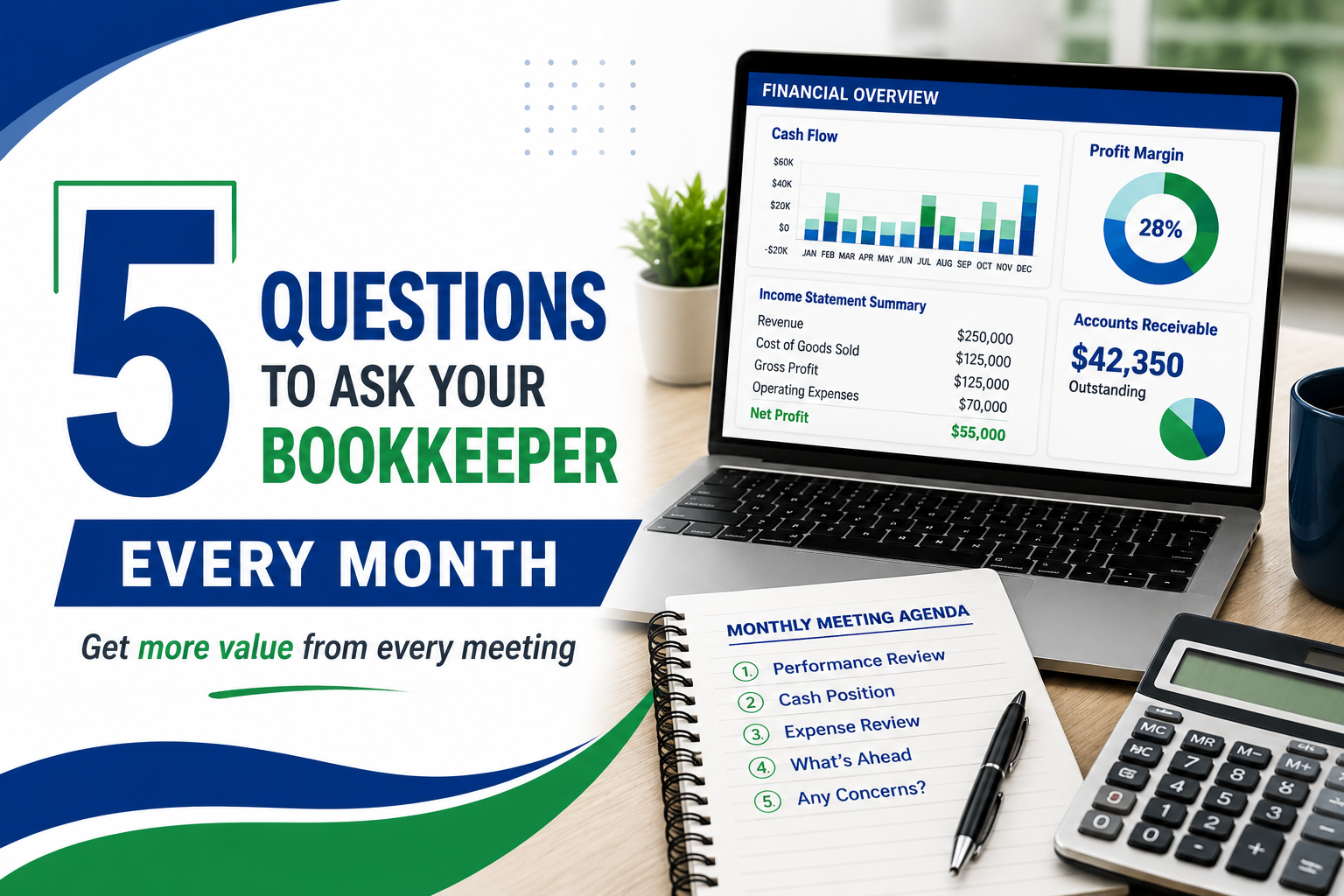
At your next monthly meeting, ask these five questions:
- How did we perform this month?
- Is our cash position healthy?
- Are there any unusual expenses or transactions?
- Is there anything I need to prepare for before next month?
- Is there anything in my books that concerns you?
You do not need to become an accountant to understand your business finances.
You simply need reliable records, regular financial reviews, and the right questions.
Conclusion
Your bookkeeping reports should help you make decisions—not sit unopened in your inbox.
A consistent monthly conversation with your bookkeeper can help you understand profitability, monitor cash, spot unusual transactions, prepare for upcoming expenses, and identify financial trends that deserve attention.
For Florida small business owners, staying organized throughout the year can also make it easier to work with your tax professional and handle federal and state compliance responsibilities when they apply.
How Accredited Bookkeeping Can Support Your Business
At Accredited Bookkeeping, we understand the challenges small businesses face when it comes to managing finances. We’re here to help you streamline your bookkeeping processes, avoid unnecessary financial errors, and gain greater clarity about your financial health. Our services are designed to fit the specific needs of your business, giving you peace of mind while you focus on growth.
Contact us today for a free consultation and discover how we can make bookkeeping easier for you.
marianne@accreditedbookkeeping.com
Marianne Kirwan
352-626-0116