What Your Books Should Show Before You Say Yes
Getting a new client or landing a large contract can be exciting. More work can mean more revenue, new opportunities, and business growth.
But more revenue does not automatically mean more profit.
A new contract may require you to spend money before you receive your first payment. You might need additional employees, independent contractors, materials, equipment, software, insurance, or other resources. If the client has longer payment terms, you could be covering those costs for weeks before the money arrives.
That is why your bookkeeping should be part of the decision before you accept a major new client.
Your financial records should help you answer one important question:
Can my business afford to take on this work and still remain financially healthy?
Here is what to review before you say yes.
1. Know How Much Cash You Actually Have
Start with your current cash position.
A profitable business can still experience cash flow problems. Your profit and loss statement might show positive results while much of your money is tied up in unpaid invoices or needed for upcoming expenses.
For example, suppose you are offered a $30,000 contract.
You estimate that you will need to spend $8,000 during the first month on labor, materials, and other project costs. However, you may not receive the client’s payment until several weeks later.
Can your business comfortably cover that $8,000 while continuing to pay its regular expenses?
Review your:
- Business bank balances
- Expected customer payments
- Accounts receivable
- Accounts payable
- Payroll
- Contractor payments
- Loan and credit card payments
- Tax obligations
- Other upcoming expenses
The goal is not simply to determine whether the contract will eventually generate money. You also need to determine whether you have enough cash to operate while waiting to get paid.
2. Calculate the Real Profit Potential
A large contract can look impressive because of its total dollar value.
What matters to your business, however, is how much money remains after the costs of completing the work.
Suppose a contract will generate $25,000 in revenue.
You estimate the following direct project costs:
- Labor: $8,000
- Materials: $4,000
- Independent contractors: $3,000
- Travel and delivery: $1,000
- Other direct costs: $1,000
Your estimated direct project costs would be $17,000.
That leaves $8,000 before considering the business’s general overhead and applicable taxes.
Now you have a much better number to evaluate.
Ask whether the expected profit is enough to justify the time, resources, and financial risk involved.
A contract that significantly increases revenue but produces very little profit may not be as attractive as it first appears.
3. Review Your Accounts Receivable
Before taking on another client, look at how much money your existing customers already owe you.
Your accounts receivable report can tell you whether too much cash is currently tied up in unpaid invoices.
Pay attention to:
- Total outstanding invoices
- Past-due invoices
- Customers who regularly pay late
- Large unpaid balances
- How long customers typically take to pay
For example, suppose your business has $40,000 in outstanding invoices and a significant portion is already overdue.
Taking on another large contract that requires substantial upfront spending could increase pressure on your cash flow.
This does not necessarily mean you should reject the opportunity.
Instead, you may need to negotiate better payment terms, request an upfront deposit when appropriate, use milestone billing, or invoice more frequently.
4. Make Sure Your Books Are Current
You cannot make a reliable financial decision using outdated numbers.
If your bookkeeping is several months behind, your reports may not reflect your current financial position.
Before accepting a major contract, make sure recent business activity has been properly recorded.
Review items such as:
- Bank transactions
- Credit card transactions
- Customer invoices
- Customer payments
- Vendor bills
- Payroll
- Contractor payments
- Loans
- Equipment purchases
- Other significant business expenses
Your bank and credit card accounts should also be reconciled so that the balances in your bookkeeping system can be compared with the actual account records.
Clean, current books give you a much clearer picture of what the business can realistically afford.
5. Understand the Cost of Additional Help
A new contract may require more people.
Before hiring, calculate the financial impact carefully.
If you need employees, your costs can extend beyond wages. Depending on the situation, the business may also have employer payroll taxes, workers’ compensation costs, benefits, equipment, payroll processing costs, and other employment-related expenses.
If you plan to use independent contractors, proper worker classification is also important.
Simply calling someone an independent contractor does not automatically make that person one for federal tax purposes. The actual working relationship matters.
Before expanding your workforce for a contract, make sure the expected revenue can support the additional costs.
6. Consider the Tax Impact
More business income can affect your tax obligations.
Depending on how your business is structured and your individual tax situation, additional profit may affect the amount you need to pay through estimated taxes or other tax payments.
This is another reason revenue should not be treated as if every dollar is available to spend.
Suppose your new client pays a $20,000 invoice.
That $20,000 is revenue, but the business may still need to cover project expenses, operating costs, payroll obligations, and taxes.
Consider discussing the expected additional income with your tax professional so you understand how the new contract could affect your tax planning.
7. Check Your Existing Debt and Financial Commitments
Look beyond your day-to-day expenses.
Your business may already have financial obligations that compete for the same cash.
Review:
- Business loan payments
- Credit card balances
- Equipment financing
- Lease payments
- Payroll commitments
- Recurring software and service costs
- Vendor payments
- Other contractual obligations
If your business is already using most of its available cash to meet existing commitments, taking on a contract that requires substantial upfront spending could create unnecessary financial pressure.
8. Watch for Client Concentration Risk
One large client can dramatically increase your revenue.
It can also make your business more dependent on a single customer.
Suppose your business currently generates $200,000 in annual revenue and a new client is expected to bring in another $100,000.
That client could quickly become a major part of your business.
Consider what would happen if the client:
- Paid late
- Reduced the amount of work
- Changed the scope of the project
- Ended the contract
- Did not renew the agreement
A large client may still be an excellent opportunity. The important thing is to understand how dependent your business could become on that relationship.
9. Review the Payment Terms Carefully
A profitable contract can still create cash flow problems if the payment terms do not match your expenses.
Suppose you need to spend $15,000 during the first month of a project.
If the contract requires you to wait a long time before receiving payment, your business may have to finance the work in the meantime.
Before signing, understand:
- When you can send invoices
- Whether a deposit is permitted
- When payments are due
- Whether milestone billing is available
- What documentation must accompany an invoice
- Who approves invoices
- Whether certain expenses will be reimbursed
- How additional work or scope changes are approved and billed
Payment timing can be just as important as the total value of the contract.
10. Run a Simple Cash Flow Scenario
Do not evaluate the opportunity based only on the best possible outcome.
Run a few scenarios before making your decision.
Expected Scenario
The project stays on budget and the client pays according to the agreed terms.
Higher-Cost Scenario
Labor, materials, or other project expenses are higher than expected.
Late-Payment Scenario
The client pays later than expected.
Then ask:
Can the business still cover payroll, vendors, taxes, debt payments, and regular operating expenses?
If a small delay or unexpected expense would create a serious cash shortage, you may need to negotiate different contract terms or build a larger cash reserve before accepting the work.
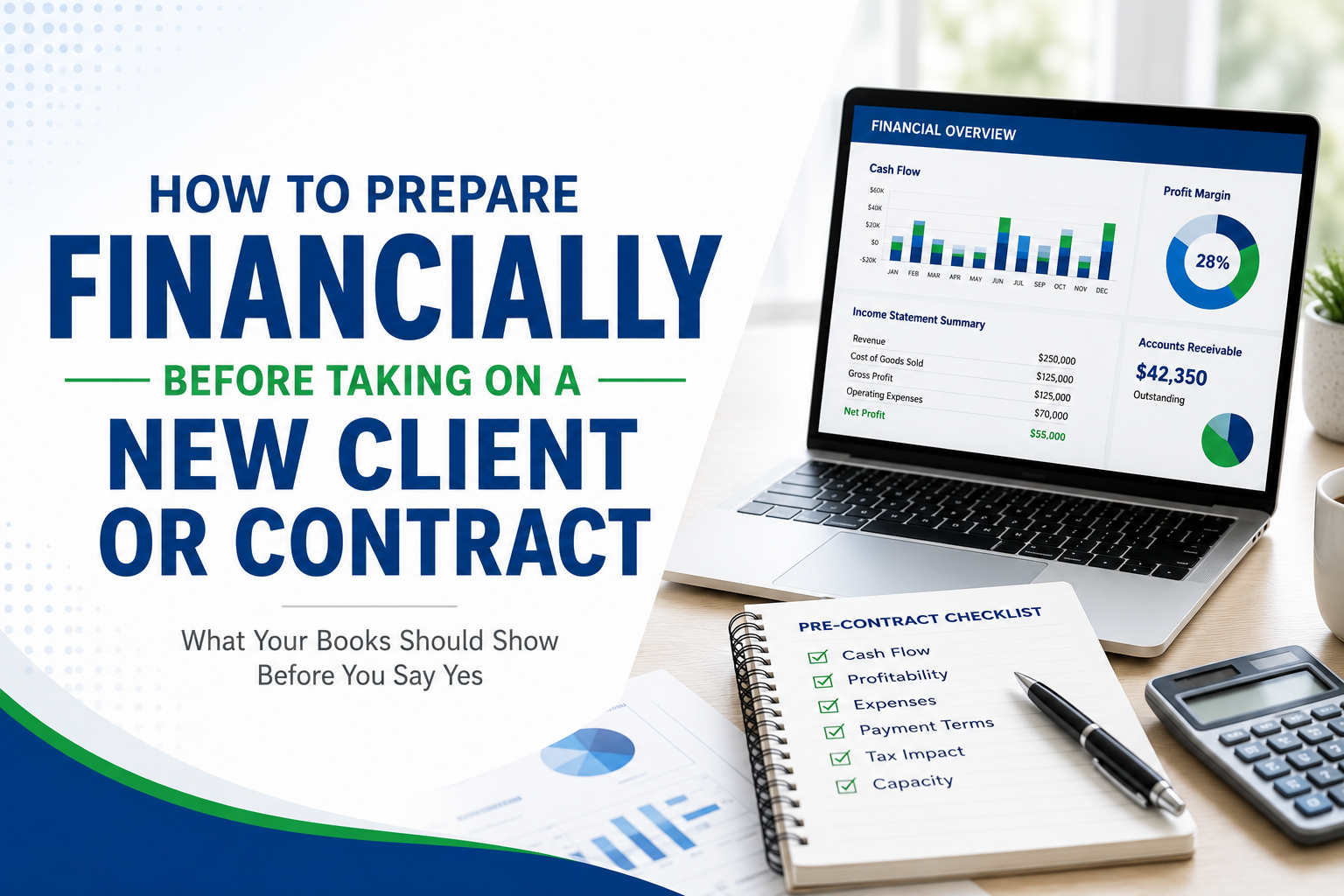
What Your Books Should Show Before You Say Yes
Before accepting a significant new client or contract, your financial records should give you a clear picture of:
- Current cash available
- Monthly revenue
- Monthly expenses
- Accounts receivable
- Accounts payable
- Existing debt obligations
- Payroll and contractor costs
- Expected project costs
- Expected project profitability
- Upcoming tax obligations
- Cash needed before receiving payment
- Revenue by customer
If you cannot easily find these numbers, your bookkeeping may need attention before you make a major financial commitment.
Create a Pre-Contract Financial Checklist
A simple financial review can become part of your process whenever a large opportunity appears.
Before accepting the contract, ask:
- How much revenue could this contract generate?
- What will it cost to complete the work?
- When will those costs have to be paid?
- When will the client pay us?
- Do we have enough cash to cover the gap?
- Will we need additional employees or contractors?
- How could the additional profit affect our tax planning?
- What happens if costs increase?
- What happens if the client pays late?
- Is the expected profit worth the workload and financial risk?
Answering these questions before signing can help you make the decision based on your actual financial position rather than revenue alone.
Good Bookkeeping Helps You Grow With Confidence
A new client should help strengthen your business, not leave you struggling to cover payroll, vendors, and other expenses while waiting to get paid.
That is one of the biggest reasons accurate bookkeeping matters.
Up-to-date financial records can help you understand where your money is going, what customers owe you, what your business owes, and whether you have enough cash to support new opportunities.
Before you say yes to your next large client or contract, look at the numbers first.
The biggest contract is not always the best contract.
The right opportunity is one your business can afford to deliver profitably.
How Accredited Bookkeeping Can Support Your Business
At Accredited Bookkeeping, we understand the challenges small businesses face when it comes to managing finances. We’re here to help you streamline your bookkeeping processes, avoid unnecessary financial errors, and gain greater clarity about your financial health. Our services are designed to fit the specific needs of your business, giving you peace of mind while you focus on growth.
Contact us today for a free consultation and discover how we can make bookkeeping easier for you.
marianne@accreditedbookkeeping.com
Marianne Kirwan
352-626-0116