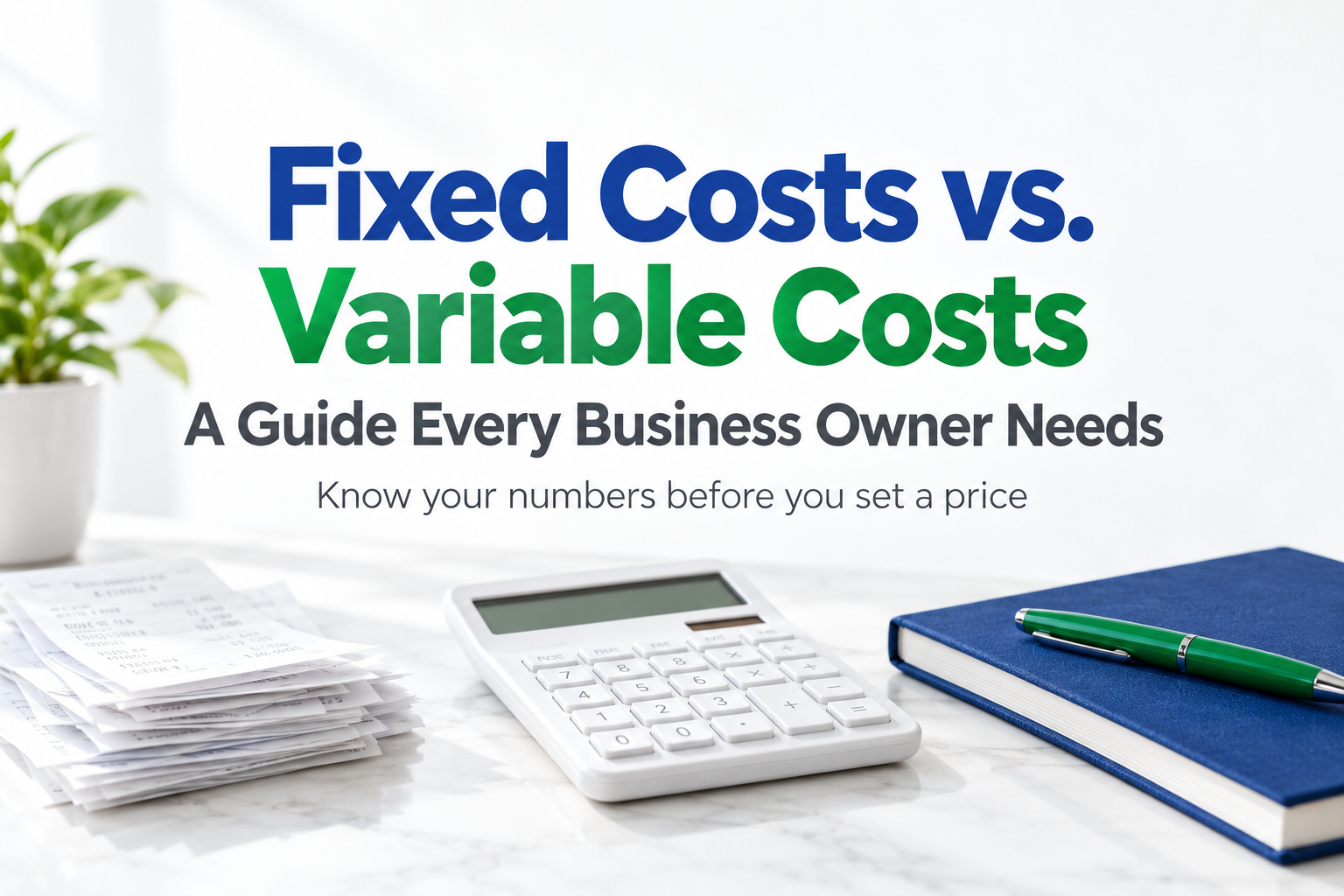
Know your numbers before you set a price
You have a full calendar, customers are paying, and sales look encouraging. Yet at the end of the month, there is less money left than you expected.
Before raising prices or taking on more work, ask yourself: Do I know what it costs to run my business and deliver each sale?
Understanding fixed and variable costs gives you a practical starting point. You can use these numbers to test a proposed price, plan a sales target, and decide whether a discount makes sense.
What Are Fixed Costs?
Fixed costs stay the same in total as business activity changes within a particular period and operating range. Examples can include a flat monthly rent payment, a fixed software subscription, or an agreed equipment lease.
“Fixed” does not mean permanent. A lease renewal can increase rent, and expansion can require additional space. The label describes how the cost behaves within the conditions you are analyzing.[1]
For a hypothetical business paying $1,500 in monthly rent:
- At 50 completed jobs, rent averages $30 per job.
- At 100 completed jobs, rent averages $15 per job.
- The total monthly rent remains $1,500 in both cases.
This distinction matters when you estimate costs per job. Dividing overhead by an unrealistic sales target can make a proposed price look more comfortable than it really is.
What Are Variable Costs?
Variable costs change in total with the activity that drives them, such as units produced or orders fulfilled. Materials used in each product are a common example.[2]
Consider a hypothetical gift shop that uses $4 of packaging for each order:
- 25 orders × $4 = $100.
- 100 orders × $4 = $400.
- 200 orders × $4 = $800.
The packaging cost per order stays at $4 in this example, while the total changes.
For your business, review product materials, per-order shipping, sales commissions, and transaction-based payment fees as possible variable costs. Check the actual agreement and usage pattern before assigning a category.
Fixed Costs vs. Variable Costs at a Glance
| Question | Fixed costs | Variable costs |
|---|---|---|
| What happens as activity changes? | Total stays constant within the operating range being analyzed | Total changes with the related activity |
| Simple example | Flat monthly rent | Packaging used per order |
| What should you track? | Amount for the period | Cost per unit and total activity |
| Pricing question to ask | How will expected sales cover this commitment? | What does one additional sale require? |
These classifications depend on cost behavior, not simply the account name.[1]
Some Costs Have Both Parts
Mixed costs contain fixed and variable components. Step costs remain unchanged across a range of activity, then jump when another level of capacity is needed.[1]
Imagine a delivery service charging your business a $100 monthly account fee plus $6 per delivery. With 40 deliveries, the bill would be:
$100 + (40 × $6) = $340
For planning, record the $100 base separately from the $240 driven by deliveries.
Similarly, avoid automatically labeling all payroll as variable. Review guaranteed pay, staffing commitments, overtime, and any job-based compensation. Ask what would actually change if your workload increased or decreased.
Why This Matters Before You Set a Price
The difference between a selling price and its variable cost is called contribution margin. It is the amount available to cover fixed costs and, after those costs are covered, contribute to profit.[2]
Here is a hypothetical business offering one standardized service:
| Item | Amount |
|---|---|
| Price per job | $150 |
| Variable cost per job | $60 |
| Monthly fixed costs | $3,600 |
For this simplified example, assume all operating costs are included in those two cost categories, jobs are comparable, and the business has enough capacity. Figures exclude income taxes and financing costs.
Contribution margin per job = $150 − $60 = $90
That $90 is not automatically profit. The business still needs to cover its $3,600 monthly fixed costs.
At 50 jobs:
- Revenue: 50 × $150 = $7,500
- Variable costs: 50 × $60 = $3,000
- Total contribution: $7,500 − $3,000 = $4,500
- Operating profit in this example: $4,500 − $3,600 = $900
If the owner treated every dollar above the $60 delivery cost as profit, the monthly result would be overstated.
How to Calculate Your Break-Even Point
Your break-even point is the sales level at which revenue covers the costs included in the calculation.
For a single product or standardized service:
Break-even units = Fixed costs ÷ (Selling price per unit − Variable cost per unit)
The SBA uses this formula in its break-even guidance. Treat the result as a planning estimate based on your assumptions.[3]
Using our example:
$3,600 ÷ ($150 − $60) = 40 jobs
At 40 jobs, revenue is $6,000. Variable costs are $2,400, leaving exactly $3,600 to cover fixed costs.
For a $1,800 monthly operating profit target under the same assumptions:
($3,600 + $1,800) ÷ $90 = 60 jobs
This gives the owner a specific question: Can the business realistically sell and complete 60 jobs at that price?
If your calculation produces a fraction, round up to the next whole sale or job.
What Happens When You Offer a Discount?
Now suppose the owner reduces the price by 10%, from $150 to $135, while variable costs remain $60 per job.
The revised calculation becomes:
- Contribution per job: $135 − $60 = $75
- Break-even point: $3,600 ÷ $75 = 48 jobs
The business now needs eight more jobs to break even.
At the original volume of 50 jobs, operating profit falls to:
(50 × $75) − $3,600 = $150
Compare that with the original $900. In this example, a 10% price reduction lowers operating profit by $750 if volume and costs remain unchanged.
Before offering a promotion, calculate the additional workload required and decide whether your team can handle it.
Turn Your Numbers Into a Practical Pricing Review
Set aside time to work through these steps:
- Choose one period. Use monthly figures consistently, rather than mixing annual commitments with monthly sales.
- Review supporting records. Gather bills, supplier invoices, payroll details, and transaction fees.
- Separate cost behavior. Identify fixed, variable, and mixed components. Flag uncertain items for your bookkeeper.
- Choose a useful unit. Depending on your business, that might be a product, order, appointment, or standardized job.
- Test realistic volumes. Calculate results for a slow month, an expected month, and a busy month.
- Check capacity. Identify whether higher volume would require another employee, vehicle, or workspace.
- Revisit your assumptions. Review pricing when supplier costs, service scope, or operating commitments change.
For custom projects, build estimates around each project’s expected resources. Avoid assuming every job has the same delivery cost.
Common Questions Business Owners Ask
Does selling more always mean earning more?
In our example, additional jobs improve operating profit only while the contribution remains positive and the stated cost assumptions hold. Check whether extra work introduces new commitments before accepting a large order.
Can I set prices using costs alone?
Use the calculation as a starting point, then consider customer demand, your service offering, and whether the proposed sales volume is realistic. A spreadsheet target still needs customers willing to buy.
What if I sell several different services?
The simple example above assumes one standardized service. For a varied business, review each offering’s contribution and the expected combination of sales before relying on one overall target.
Know Your Costs Before Your Next Quote
Start with one product or service. Write down its selling price, variable cost, and the monthly fixed costs your sales must support. Then test the result against a realistic workload.
You will have a clearer basis for your next pricing decision and more useful questions to bring to your bookkeeper.
How Accredited Bookkeeping Can Support Your Business
At Accredited Bookkeeping, we understand the challenges small businesses face when it comes to managing finances. We’re here to help you streamline your bookkeeping processes, avoid unnecessary financial errors, and gain greater clarity about your financial health. Our services are designed to fit the specific needs of your business, giving you peace of mind while you focus on growth.
Contact us today for a free consultation and discover how we can make bookkeeping easier for you.
marianne@accreditedbookkeeping.com
Marianne Kirwan
352-626-0116