You may not be ready to sell your business today. Perhaps you are thinking about retirement, hoping to pass it to a family member, or simply keeping your options open.
Whatever your timeline, your bookkeeping deserves a place in that plan.
When buyers evaluate a business, they need more than a promising story. They need reliable information about earnings, expenses, assets, and obligations. Clean books help you support that story with evidence.
Accurate records do not automatically increase what someone will pay. They can, however, help you demonstrate value, identify problems early, and reduce uncertainty that could weaken negotiations.
What Does “Clean Books” Actually Mean?
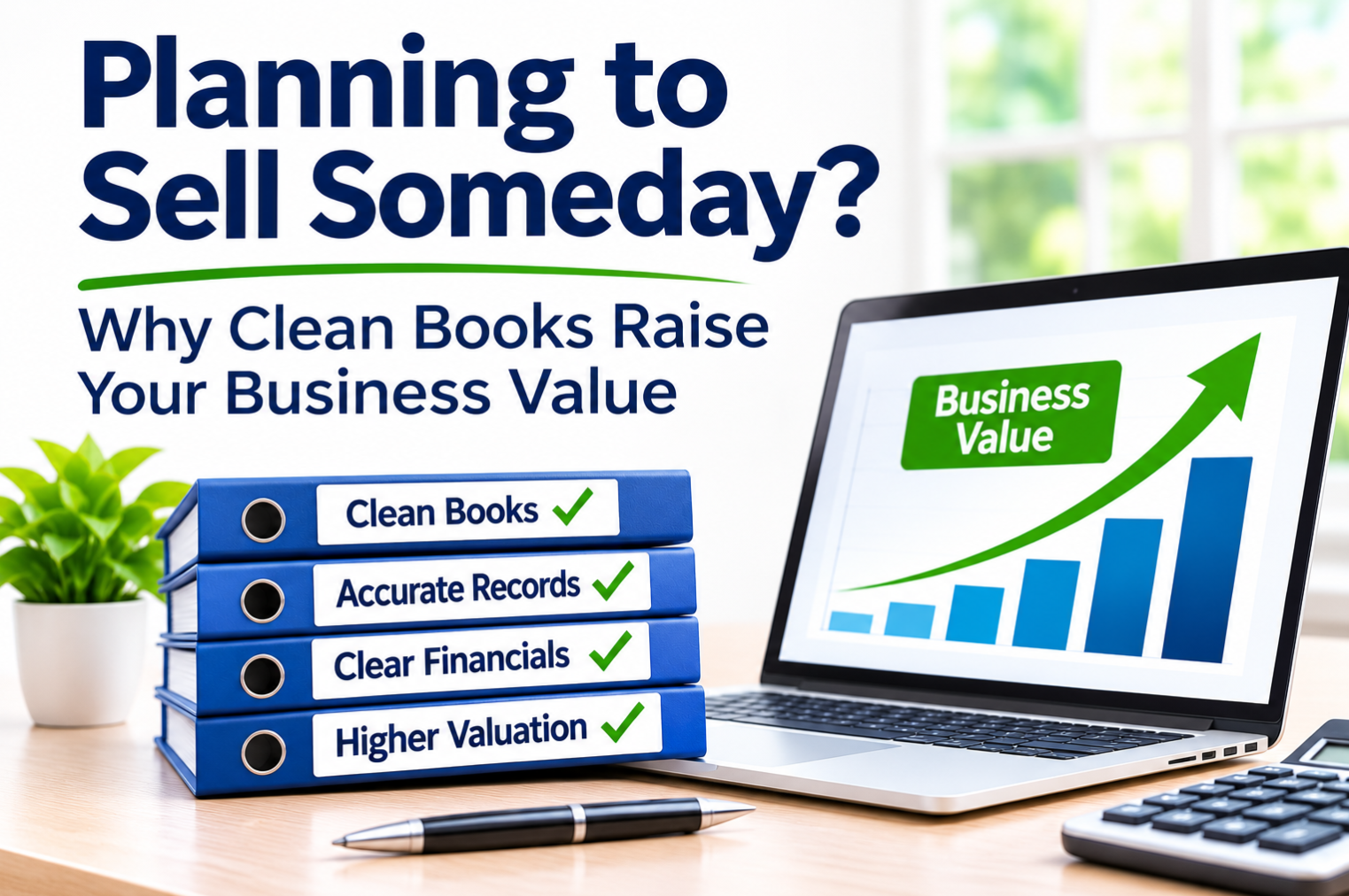
Clean books are financial records that are accurate, current, consistent, and supported by documentation.
In practice, that means your accounts are reconciled, transactions are categorized appropriately, and reported balances can be explained. Customer invoices, supplier bills, payroll records, and other supporting documents should be organized and accessible.
The IRS explains that a good recordkeeping system summarizes business transactions and connects them to supporting records. Electronic systems must also provide complete and accurate information.
A useful test: If someone asked about a large expense from six months ago, could you explain it and find the supporting document without searching through scattered emails?
1. Buyers Can See What the Business Actually Earns
Strong sales are encouraging, but buyers also need to understand what remains after the costs of running the business.
Financial statements help reveal whether revenue growth is accompanied by healthy earnings, whether expenses are increasing, and whether results are consistent across periods.
BDO’s preparation-for-sale guidance notes that buyers closely examine financial information to assess cash flows and the way a company generates earnings. Unexplained inconsistencies can make that assessment harder.
Example: Imagine two businesses reporting similar annual revenue. One provides consistent monthly reports with documented expenses. The other provides a single spreadsheet with missing months and unexplained totals.
The first business is easier to evaluate. That does not establish a higher price by itself, but it gives the buyer a stronger basis for assessing the seller’s claims.
Action step: Review your profit and loss statement monthly. Investigate changes in revenue, direct costs, and operating expenses while the details are still fresh.
2. Clear Records Help Support a Realistic Valuation
A business’s value is not simply the cash in its bank account or the amount the owner hopes to receive.
The U.S. Small Business Administration describes income, market, and asset approaches to valuation. These approaches consider different information, including future performance, comparable business sales, and assets and liabilities.
Accurate bookkeeping supplies part of the information a valuation professional needs. It does not replace a valuation or determine which method is appropriate.
Action step: Maintain a current balance sheet alongside your profit and loss report. Review loan balances, equipment records, customer receivables, and supplier obligations so your financial picture includes more than revenue.
3. Documented Adjustments Are Easier to Evaluate
A buyer or adviser may examine adjustments intended to show the business’s ongoing earning capacity. These are sometimes called normalization adjustments or add-backs.
Certain unusual expenses may warrant consideration, but an expense does not qualify simply because the seller wants it removed.
Owner compensation, related-party transactions, and nonrecurring items require careful review. Some adjustments increase the earnings figure being analyzed; others reduce it. The work needed to replace an owner’s ongoing duties also matters.
Hypothetical example: A business reports $120,000 in earnings and proposes a $10,000 adjustment for a genuinely nonrecurring expense.
If the buyer and advisers accept that adjustment, the simplified calculation is:
$120,000 + $10,000 = $130,000 in adjusted earnings.
This is not an automatic valuation increase. The expense must be supported, the adjustment must be appropriate, and the valuation method must account for it.
Action step: Keep a separate schedule of proposed adjustments with dates, amounts, explanations, and supporting documents. Preserve your original accounting records rather than rewriting them to produce a more attractive number.
4. Organized Records Make Due Diligence More Manageable
Due diligence is the buyer’s process of checking the business before completing the transaction.
Financial requests may include historical and current statements, tax returns, bank records, projections, and detailed supporting schedules. The scope depends on the business and the transaction.
A quality of earnings review may also be appropriate. It examines issues such as sustainable earnings, unusual adjustments, and working capital. It is different from a financial statement audit and is not automatically necessary for every sale.
Ask your transaction advisers what level of reporting is appropriate before commissioning additional work.
Action step: Start a secure folder for sale preparation. Organize files by year and document type, use clear names, and discuss confidentiality with your advisers before sharing sensitive information.
5. Balance Sheet Cleanup Can Reveal Hidden Problems
A profit figure does not explain every financial issue a buyer may encounter.
Old customer balances, outdated inventory, unresolved liabilities, and inaccurate debt records can complicate the picture. The FDIC’s guidance on preparing a business for sale recommends addressing outstanding issues, organizing records, and having recent financial statements ready.
Use a recurring review to identify items that need attention:
| Area | Question to ask |
| Customer receivables | Which balances are overdue, disputed, or unlikely to be collected? |
| Supplier payables | Are all outstanding bills recorded and assigned correctly? |
| Inventory | Do records reflect actual quantities and obsolete items? |
| Debt | Do recorded balances agree with current lender statements? |
| Equipment | Are purchases, disposals, and ownership records complete? |
Action step: Discuss necessary corrections with your bookkeeper or accountant. Accurate reporting may reveal that an asset is worth less than expected. Finding that out early is more useful than discovering it during negotiations.
Start Preparing Before “Someday” Arrives
You do not need to wait until you have a buyer to improve your records.
Build these habits into your normal routine:
- Reconcile bank and credit card accounts every month.
- Keep personal spending separate from business activity.
- Review uncategorized transactions and unusual balances promptly.
- Save invoices, receipts, contracts, and supporting schedules.
- Compare financial results consistently across periods.
- Document how recurring bookkeeping tasks are completed.
- Explain legitimate differences between internal reports and tax returns with your accountant’s help.
Good records also help you manage the business while you still own it. They give you a clearer starting point for decisions about pricing, expenses, collections, and investment.
Protect the Value You Have Worked to Build
Clean books cannot replace a strong business model, loyal customers, or sustainable earnings. They help make those strengths easier to evaluate.
Preparing early gives you time to resolve problems and explain your results with confidence. When selling becomes a real possibility, involve a qualified valuation professional, tax adviser, and attorney to assess the transaction and its implications.
How Accredited Bookkeeping Can Support Your Business
At Accredited Bookkeeping, we understand the challenges small businesses face when it comes to managing finances. We’re here to help you streamline your bookkeeping processes, avoid unnecessary financial errors, and gain greater clarity about your financial health. Our services are designed to fit the specific needs of your business, giving you peace of mind while you focus on growth.
Contact us today for a free consultation and discover how we can make bookkeeping easier for you.
marianne@accreditedbookkeeping.com
Marianne Kirwan
352-626-0116