When you hear the words balance sheet, you probably think of accounting software, financial statements, or tax season—not medieval Italy.
Yet the balance sheet is one of the oldest business tools still used today. Long before spreadsheets and cloud accounting, merchants relied on it to keep track of wealth, debts, and business performance. Remarkably, the same core principles developed centuries ago continue to help today’s business owners make smarter financial decisions.
Understanding where the balance sheet came from isn’t just an interesting history lesson. It reveals why this simple financial statement remains one of the most powerful tools for running a successful business.
The Origins of the Balance Sheet
The roots of the balance sheet stretch back to medieval Europe, when trade between cities expanded rapidly. As merchants bought, sold, borrowed, and invested across long distances, they needed a reliable way to record financial transactions.
By the 13th and 14th centuries, Italian merchants were using early forms of double-entry bookkeeping, a revolutionary method that recorded every transaction in two places to help detect errors and accurately track business finances.
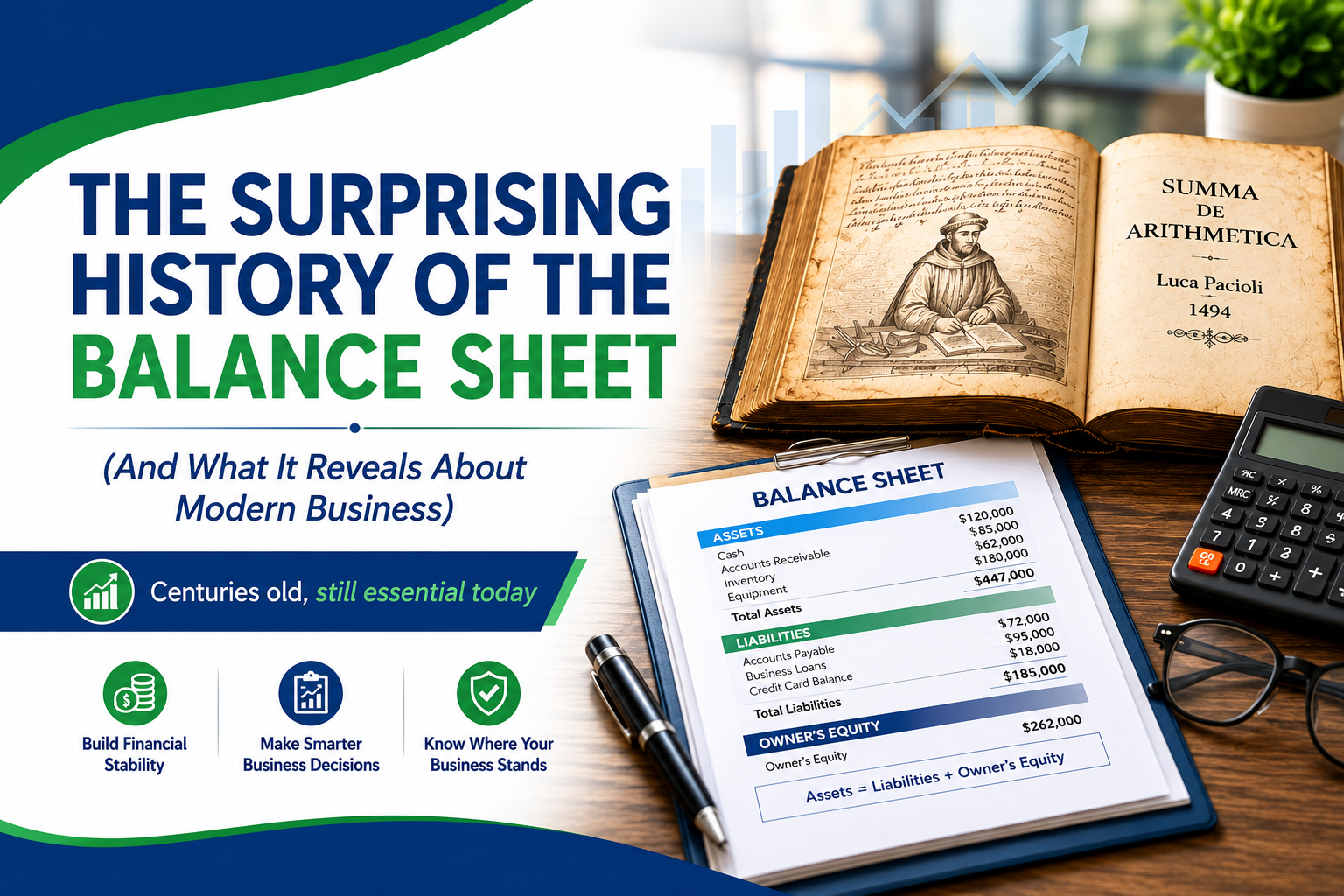
In 1494, Italian mathematician and Franciscan friar Luca Pacioli published Summa de Arithmetica, the first widely distributed book explaining double-entry bookkeeping. While Pacioli did not invent the system, his work documented and standardized the accounting methods already used by Venetian merchants, helping spread them throughout Europe.
Because of this contribution, Pacioli is often called the “Father of Accounting.”
What Exactly Is a Balance Sheet?
A balance sheet provides a snapshot of a business’s financial position at a specific point in time.
It answers one simple question:
What does the business own, what does it owe, and what’s left for the owner?
The statement is organized into three sections:
Assets
Assets are everything the business owns or controls that has value.
Examples include:
-
- Cash
-
- Bank accounts
-
- Equipment
-
- Vehicles
-
- Inventory
- Accounts receivable
Liabilities
Liabilities represent money the business owes.
Common examples include:
-
- Business loans
-
- Credit cards
-
- Payroll taxes owed
-
- Vendor bills
- Lines of credit
Owner’s Equity
Owner’s equity represents the owner’s financial interest after liabilities are subtracted from assets.
This relationship is expressed through the famous accounting equation:
Assets = Liabilities + Owner’s Equity
This equation has remained the foundation of bookkeeping for more than 500 years.
Why Has the Balance Sheet Lasted So Long?
Business has changed dramatically.
Paper ledgers became calculators.
Calculators became spreadsheets.
Spreadsheets became cloud accounting software.
But the balance sheet remains virtually unchanged because it answers timeless business questions:
-
- Can this business pay its bills?
-
- Is it growing?
-
- Is it carrying too much debt?
-
- Is it financially healthy?
Whether you’re running a neighborhood landscaping company or a nationwide retailer, these questions still matter.
A Modern Example
Imagine Sarah owns a small bakery.
Her balance sheet shows:
Assets
-
- Cash: $22,000
-
- Equipment: $45,000
-
- Inventory: $8,000
Total Assets: $75,000
Liabilities
-
- Equipment loan: $18,000
-
- Credit card balance: $7,000
Total Liabilities: $25,000
Owner’s Equity
$50,000
At a glance, Sarah can see that her business owns more than it owes, giving her confidence when applying for financing or planning future growth.
What the Balance Sheet Doesn’t Tell You
While incredibly useful, a balance sheet isn’t the complete financial picture.
It does not show:
-
- Monthly profits
-
- Cash coming in tomorrow
-
- Sales trends
-
- Customer growth
-
- Future performance
That’s why business owners should review it alongside:
-
- Profit and Loss Statement (Income Statement)
-
- Cash Flow Statement
-
- Budget reports
-
- Financial forecasts
Together, these reports provide a more complete view of a company’s financial health.
Why Small Business Owners Should Care
Many entrepreneurs focus only on sales.
Others watch only the money in the bank.
Neither tells the whole story.
A growing business can still experience cash shortages, carry excessive debt, or have customers who pay too slowly.
Reviewing your balance sheet regularly helps you:
-
- Monitor financial stability
-
- Identify rising debt
-
- Prepare for loan applications
-
- Make informed investment decisions
-
- Understand your company’s overall value
For lenders and investors, the balance sheet is often one of the first financial reports they review.
Technology Has Changed—The Principles Haven’t
Today’s bookkeeping software can generate a balance sheet in seconds.
Platforms like QuickBooks Online and Xero automatically organize transactions and produce financial reports with just a few clicks.
But while technology has made bookkeeping faster, it hasn’t changed the underlying principles established centuries ago.
Every accurate balance sheet still depends on proper bookkeeping and reliable financial records.
Common Balance Sheet Mistakes
Small businesses often make avoidable errors that reduce the usefulness of their balance sheet.
Some of the most common include:
-
- Failing to reconcile bank accounts
-
- Recording personal expenses as business expenses
-
- Forgetting to update loan balances
-
- Not tracking accounts receivable
-
- Leaving old assets on the books after disposal
Keeping your records current helps ensure your balance sheet reflects your true financial position.
The Biggest Lesson From History
The balance sheet has survived wars, economic crises, industrial revolutions, and the digital age.
Why?
Because successful businesses have always needed reliable financial information to make sound decisions.
Centuries ago, merchants relied on handwritten ledgers.
Today, business owners rely on cloud accounting.
The tools have evolved, but the purpose remains exactly the same: understanding where your business stands financially so you can make informed decisions about its future.
Conclusion
The balance sheet may have originated more than 500 years ago, but it remains one of the most valuable reports a business owner can use.
Whether you’re applying for financing, planning for growth, or simply monitoring your company’s financial health, your balance sheet provides the insight needed to make confident decisions.
How Accredited Bookkeeping Can Support Your Business
At Accredited Bookkeeping, we understand the challenges small businesses face when it comes to managing finances. We’re here to help you streamline your bookkeeping processes, avoid unnecessary financial errors, and gain greater clarity about your financial health. Our services are designed to fit the specific needs of your business, giving you peace of mind while you focus on growth.
Contact us today for a free consultation and discover how we can make bookkeeping easier for you.
marianne@accreditedbookkeeping.com
Marianne Kirwan
352-626-0116