Introduction
Your profit and loss statement says your business made money. So why does your bank account feel empty?
This is one of the most frustrating situations a small business owner can face. Sales may be strong, customers may be happy, and your financial statements may even show a healthy profit. Yet when payroll, rent, taxes, or supplier bills come due, there may not be enough cash available.
The reason is simple: profit and cash flow are not the same thing.
Understanding the difference can help you make better financial decisions, prepare for upcoming expenses, and spot cash shortages before they become serious problems.
What Is Profit?
Profit measures whether your business earned more revenue than it incurred in expenses over a specific period.
In simple terms:
Revenue – Expenses = Profit
For example, suppose your business reports $50,000 in revenue for the month and $35,000 in expenses. Your accounting records may show a $15,000 profit.
But that does not necessarily mean you have an extra $15,000 sitting in your business bank account.
Why?
Because accounting profit measures financial performance, while your bank balance reflects the actual movement and timing of cash.
What Is Cash Flow?
Cash flow tracks money moving into and out of your business.
Cash inflows can include customer payments, loan proceeds, owner contributions, and other money received.
Cash outflows can include payroll, rent, inventory purchases, loan payments, taxes, equipment purchases, and other bills.
A business has positive cash flow when more cash comes in than goes out during a particular period. Negative cash flow occurs when more cash leaves than enters.
A company can therefore report a profit while experiencing negative cash flow.
The Cash Flow Gap Explained
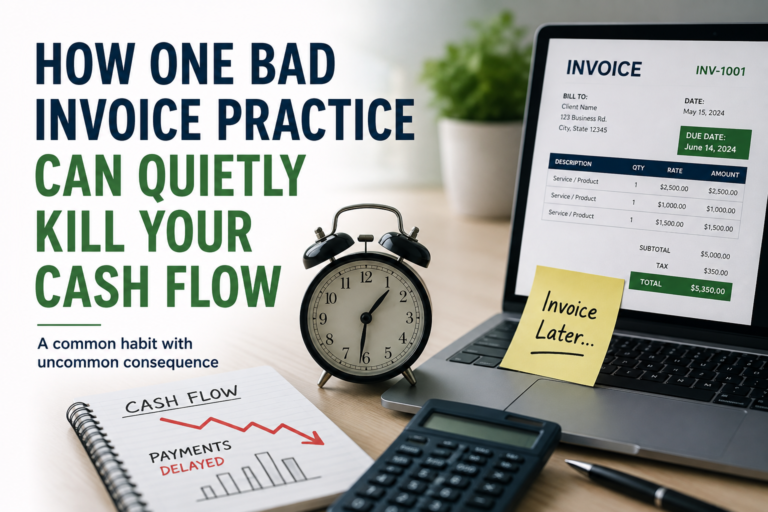
A cash flow gap occurs when there is a timing difference between when your business must spend money and when it receives money.
Imagine a small service business completes $20,000 worth of work in October and invoices its customers immediately.
Depending on the business’s accounting method, some or all of that revenue may be reflected in its financial records before the customers actually pay. If customers have 30-day payment terms, the business might not receive the cash until November or December.
Meanwhile, October payroll, rent, software subscriptions, insurance, and other bills still need to be paid.
The business may look profitable on paper while struggling to cover its immediate obligations.
That is the cash flow gap.
6 Reasons a Profitable Business Can Run Short on Cash
1. Customers Have Not Paid Yet
Accounts receivable can create one of the clearest differences between profit and available cash.
You may have earned revenue, but if customers have not paid their invoices, that money is not yet available in your bank account.
For example, a contractor may finish a $15,000 project and issue an invoice. The business has completed the work, but if the customer takes 45 days to pay, the contractor still needs enough cash to cover employees, subcontractors, materials, fuel, and other costs during those 45 days.
The longer customers take to pay, the greater the potential pressure on cash flow.
2. You Purchased Too Much Inventory
Inventory requires cash.
A retail business might spend $25,000 stocking up for the holiday season. Those products may eventually generate profitable sales, but the business has already spent the cash.
Until the inventory sells and customers pay, that money is tied up in products sitting on shelves or in a warehouse.
Good inventory management is therefore also part of good cash flow management.
3. Loan Payments Use Cash
Borrowing money creates another important difference between profit and cash.
A loan payment can include both principal and interest. Interest is generally an expense for accounting purposes, subject to applicable accounting and tax rules. The principal portion reduces the loan balance rather than being treated as a normal operating expense.
But both portions require cash to leave your bank account.
A business can therefore make a profit while significant debt payments reduce the cash it has available.
4. Equipment and Other Major Purchases Consume Cash
Suppose your company buys a $30,000 piece of equipment with cash.
The full $30,000 leaves your bank account immediately. However, depending on the applicable accounting and tax treatment, the cost may not appear as a $30,000 expense on that month’s profit and loss statement.
For financial accounting, a capital asset is generally recorded on the balance sheet and its cost is allocated over its useful life through depreciation.
This creates another situation where your reported profit and cash balance can move very differently.
5. Taxes Can Create Large Cash Outflows
Tax obligations can put pressure on cash when businesses do not plan for them throughout the year.
For example, certain individuals, including sole proprietors, partners, and S corporation shareholders, may need to make estimated tax payments if they expect to owe tax when filing. The IRS divides estimated tax into four payment periods with specific due dates.
Businesses with employees also need to account for payroll tax deposits. Federal employment tax deposit schedules can be monthly or semiweekly depending on the employer’s applicable lookback-period tax liability, with special rules also applying in certain situations.
The important cash-flow lesson is straightforward: money reserved for taxes should not be treated as freely available operating cash.
6. Growth Can Actually Increase the Cash Flow Gap
Rapid growth sounds like the solution to financial problems, but growth itself requires cash.
A growing business may need to hire employees, purchase inventory, increase marketing, lease additional space, or buy equipment before the resulting revenue is collected.
Consider a company that wins several large contracts at once. That sounds great, but the company may need to pay workers and suppliers weeks before customers pay their invoices.
Sales increase. Profit may increase. Yet the cash shortage can become more severe.
This is sometimes called overtrading, where a business grows faster than its available working capital can comfortably support.
Why Your Bank Balance Does Not Tell the Whole Story
Checking your bank account is important, but your current balance alone does not tell you how financially healthy your business is.
Imagine you see $40,000 in your business checking account.
That may look comfortable until you consider that $12,000 is needed for upcoming payroll, $8,000 is owed to suppliers, $5,000 has been set aside for taxes, and several other bills are due soon.
Your bank balance tells you what cash is there today. Good bookkeeping helps explain where that money came from, what obligations are outstanding, and what may happen next.
Florida Businesses Should Plan for Sales Tax Cash Flow Too
For Florida businesses that collect sales and use tax, collected tax should be carefully tracked rather than viewed as ordinary business income.
The Florida Department of Revenue states that sales and use tax returns and payments are generally due on the first day of the month following the reporting period and become late after the 20th. Reporting frequency can vary, so businesses should follow the schedule assigned to them. Florida also requires a return for each reporting period even when no tax is due.
Keeping sales tax funds properly tracked can help prevent a cash shortage when the payment is due.
How to Reduce Your Cash Flow Gap
Small business owners can take several practical steps to improve cash management:
- Invoice customers promptly. Send invoices as soon as work is completed or according to the agreed billing schedule.
- Monitor accounts receivable. Review unpaid invoices regularly and follow up on overdue balances.
- Create a cash flow forecast. Estimate expected cash coming in and payments going out over the next several weeks or months.
- Plan for taxes. Track tax obligations and consider keeping money reserved for taxes separate from funds available for normal operations.
- Watch inventory levels. Avoid unnecessarily tying up cash in inventory that moves slowly.
- Review payment terms. Where appropriate, evaluate customer payment terms and negotiate reasonable supplier terms that better match your cash cycle.
- Plan major purchases. Before buying equipment or making another large investment, consider what the purchase will do to your available cash.
- Maintain accurate books. Up-to-date bookkeeping makes it easier to see receivables, payables, debt, expenses, and other obligations that a bank balance alone cannot show.
Use a Cash Flow Forecast Before Problems Appear
A cash flow forecast does not need to be complicated.
Start with your expected beginning cash balance. Add the cash you reasonably expect to collect. Then subtract expected cash payments, including payroll, rent, suppliers, loan payments, taxes, subscriptions, insurance, and planned purchases.
For example:
Beginning cash: $30,000
Expected customer payments: +$25,000
Expected cash available: $55,000
Payroll and operating expenses: -$35,000
Taxes and loan payments: -$12,000
Projected ending cash: $8,000
That $8,000 figure gives the owner a very different perspective than simply seeing $30,000 in the bank at the beginning of the period.
Forecasting can help you identify a potential shortage early enough to adjust spending, accelerate collections, reconsider a purchase, or discuss financing needs with an appropriate financial professional or lender.
Profit Matters, but Timing Matters Too
Profitability is essential for the long-term health of most businesses. But profit alone does not guarantee that you will have enough cash available when bills are due.
A business owner should understand both:
“Is my business profitable?”
and
“Will I have enough cash to meet upcoming obligations?”
Those are different questions, and both deserve attention.
Conclusion
A profitable business can still experience serious financial pressure when cash comes in later than expenses need to be paid.
Unpaid customer invoices, inventory purchases, debt payments, equipment investments, taxes, and rapid growth can all create a gap between reported profit and available cash.
Accurate bookkeeping helps make that gap visible. By keeping financial records current, monitoring receivables and payables, planning for taxes, and forecasting future cash needs, small business owners can make decisions based on more than today’s bank balance.
How Accredited Bookkeeping Can Support Your Business
At Accredited Bookkeeping, we understand the challenges small businesses face when it comes to managing finances. We’re here to help you streamline your bookkeeping processes, avoid unnecessary financial errors, and gain greater clarity about your financial health. Our services are designed to fit the specific needs of your business, giving you peace of mind while you focus on growth.
Contact us today for a free consultation and discover how we can make bookkeeping easier for you.
marianne@accreditedbookkeeping.com
Marianne Kirwan
352-626-0116