Lessons from Centuries of Financial Record-Keeping
Introduction
Accounting software, cloud storage, automated bank feeds, and digital receipts may seem thoroughly modern, but the basic ideas behind bookkeeping are remarkably old.
Thousands of years before spreadsheets and accounting apps existed, merchants, governments, temples, and landowners needed ways to answer familiar business questions: How much came in? How much went out? Who owes us? What do we own? Where did the money or goods go?
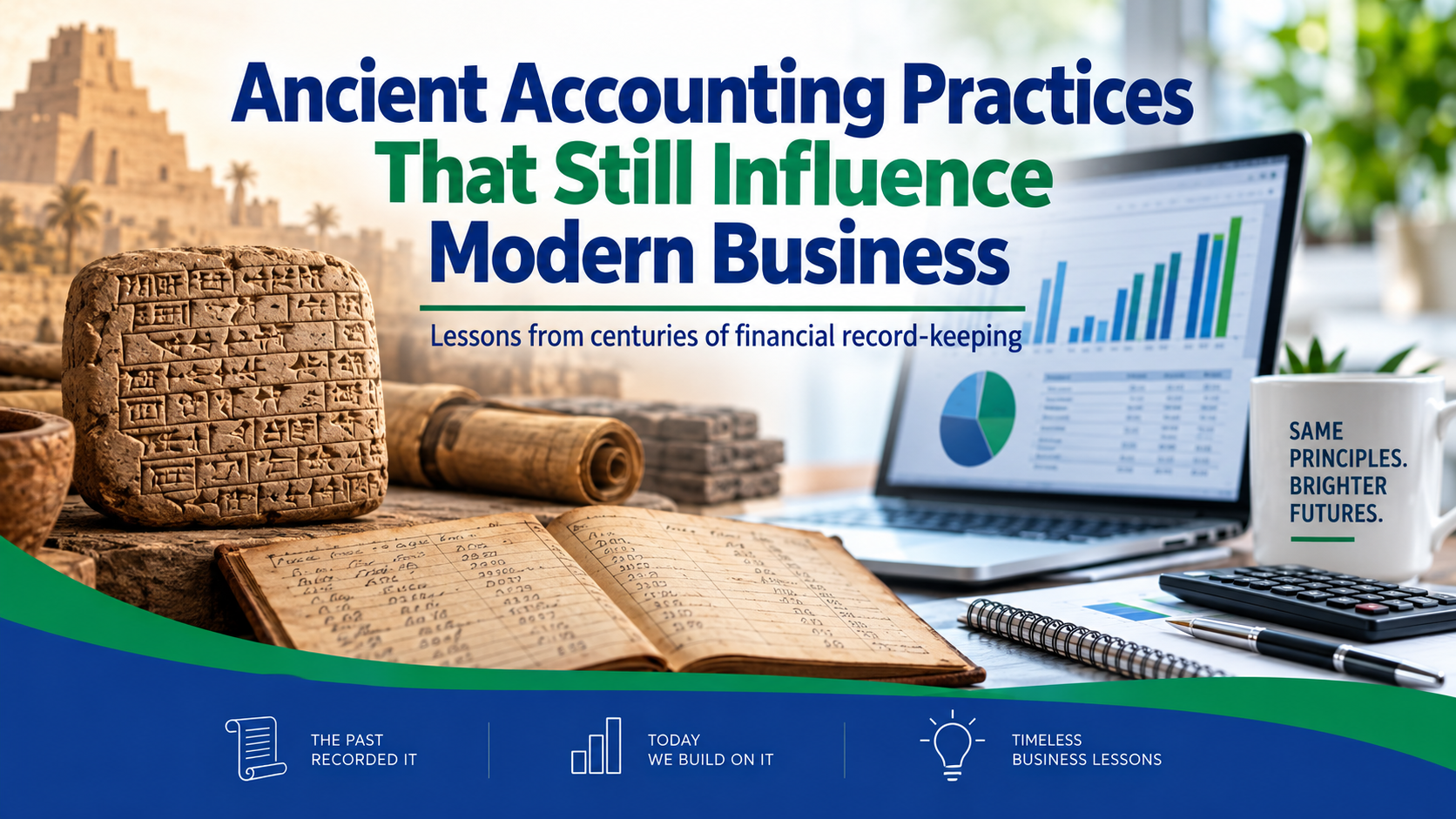
Some of the oldest surviving accounting records come from ancient Mesopotamia. The Library of Congress has cuneiform tablets containing records related to receipts and payments for goods and services, while other surviving tablets document tax assessments and payments. Some date back roughly 4,000 years.
The technology has changed dramatically. The fundamental need for accurate, organized financial information has not.
Here are several ancient accounting principles that continue to influence how modern businesses manage their finances.
1. Record Every Transaction
One of the most important ideas in bookkeeping is also one of the oldest: financial activity should be documented.
Ancient Mesopotamian administrators recorded transactions involving commodities, livestock, taxes, and other economic activity on clay tablets. These records helped communities track what was received, distributed, paid, or owed.
Modern businesses follow the same principle, although today’s records may include:
- Sales receipts
- Customer invoices
- Vendor bills
- Bank transactions
- Credit card purchases
- Payroll records
- Expense receipts
- Loan payments
The IRS says a business’s recordkeeping system should clearly show its income and expenses. Supporting documents can include invoices, receipts, deposit records, paid bills, and other evidence of transactions.
The Modern Business Lesson
Don’t rely on memory.
Imagine a landscaping company owner buys $600 of equipment and materials but never saves the invoice or properly records the purchase. Months later, when reviewing the books or preparing a tax return, determining exactly what was purchased and how it should be treated becomes much harder.
Recording transactions when they happen creates a much clearer financial history.
2. Organize Financial Information Into Categories
Recording transactions is only the beginning. Businesses also need a system for organizing them.
Modern accounting uses accounts and categories to separate financial activity. Revenue may be divided by type, while expenses might be categorized as advertising, supplies, rent, insurance, payroll, or professional services.
The IRS still describes journals and ledgers as fundamental components of business recordkeeping. A journal records transactions, while a ledger organizes information into different accounts.
Why Categories Matter
Suppose a Florida restaurant spends $25,000 during a month.
Knowing the total expense is useful, but it doesn’t tell the owner much.
Breaking that amount down might reveal:
- $10,000 for food and supplies
- $7,000 for payroll-related costs
- $4,000 for rent
- $2,000 for utilities
- $2,000 for other operating expenses
Now the owner has information that can help with budgeting and business decisions.
Good bookkeeping doesn’t simply record money. It explains where the money went.
3. Keep Evidence Behind the Numbers
Ancient records weren’t valuable simply because numbers were written down. Their value came from documenting real economic events.
That principle remains essential today.
A transaction appearing in accounting software is useful, but businesses should also retain appropriate supporting documentation.
According to the IRS, supporting documents can include receipts, invoices, paid bills, deposit slips, canceled checks, and other records. These documents help support entries in the books and information reported on tax returns.
A Bank Statement Isn’t Always the Whole Story
Suppose your business credit card statement shows:
Office Store — $847
That proves a transaction occurred, but it may not explain what was purchased or whether every item qualifies as a business expense.
An itemized receipt or invoice provides additional information.
That’s why organized documentation remains an important part of bookkeeping.
4. Track What the Business Owns and Owes
For centuries, successful commerce has depended on understanding resources and obligations.
Modern bookkeeping formalizes this through the balance sheet.
A balance sheet generally shows three major areas:
Assets — what the business owns or controls.
Liabilities — what the business owes.
Equity — the owner’s financial interest in the business.
The IRS notes that accurate records are needed to prepare financial statements, including income statements and balance sheets.
Example
A business may have $100,000 in assets.
That sounds impressive.
But if the company also has $85,000 in liabilities, looking only at the assets gives an incomplete picture.
This is one reason bookkeeping matters: business owners need context, not just account balances.
5. Double-Entry Bookkeeping Changed Business
One of the most influential developments in accounting history was the formal description of double-entry bookkeeping.
Italian mathematician and Franciscan friar Luca Pacioli published Summa de Arithmetica, Geometria, Proportioni et Proportionalita in Venice in 1494. His work included a description of bookkeeping practices and became an important milestone in accounting history.
Pacioli did not simply invent accounting from nothing. Bookkeeping practices had developed over time. His importance comes largely from documenting and explaining a systematic approach.
What Is Double-Entry Bookkeeping?
At its simplest, double-entry accounting recognizes that financial transactions affect at least two accounts.
For example, suppose a business buys a $2,000 computer with cash.
The business:
- Gains $2,000 of equipment
- Gives up $2,000 of cash
Two parts of the financial picture have changed.
Modern accounting systems can perform much of this process behind the scenes, but the underlying logic continues to support financial reporting today.
6. Reconciliation Is About Trusting the Records
A set of books isn’t useful merely because transactions were entered. The information also needs to be checked.
Modern businesses accomplish this partly through reconciliation.
Bank reconciliation compares transactions recorded in the company’s books with activity reported by the financial institution.
The IRS specifically recommends checking business accounts for errors by reconciling them.
Why Reconciliation Matters
Suppose your bookkeeping records show $18,500 in the bank, but the bank statement shows $17,900.
That $600 difference deserves investigation.
Possible explanations could include:
- A duplicate transaction
- A missing expense
- An outstanding payment
- A bank fee
- An incorrectly entered amount
- A transaction posted to the wrong account
Regular reconciliation helps identify these issues before they accumulate.
7. Separate Business Activity From Personal Activity
Organized accounting works best when business transactions can be clearly identified.
This is particularly important for small business owners who may otherwise mix personal and business spending.
IRS Publication 583 recommends using a business account for business purposes and explains the importance of identifying deposits as business income, personal funds, or loans.
Practical Example
Imagine a business owner uses the same checking account for:
- Customer payments
- Grocery shopping
- Business insurance
- Mortgage payments
- Advertising
- Family vacations
- Office supplies
Determining the true performance of the business becomes unnecessarily difficult.
Using dedicated business financial accounts and maintaining organized books makes the financial picture much clearer.
8. Good Records Help Business Owners Make Decisions
Ancient accounting records helped administrators understand resources and obligations.
Modern bookkeeping serves an even broader management purpose.
The IRS notes that good records can help businesses monitor progress, identify income sources, track deductible expenses, prepare financial statements, prepare tax returns, and support information reported on those returns.
For a small business owner, good bookkeeping can help answer questions such as:
Is revenue increasing?
Are expenses growing faster than sales?
Which services generate the most income?
How much does the business owe?
Can the business afford a new employee?
Is there enough cash available for upcoming bills?
Those aren’t simply accounting questions. They’re business-management questions.
9. Technology Changes, but the Principles Remain
We’ve gone from clay tablets to paper ledgers, desktop spreadsheets, accounting software, cloud platforms, and automated transaction feeds.
But technology doesn’t eliminate the need for good bookkeeping.
A modern accounting system still depends on several timeless principles:
- Record transactions accurately.
- Keep supporting documentation.
- Categorize financial activity consistently.
- Track assets and obligations.
- Reconcile accounts regularly.
- Maintain organized records.
- Review financial information to understand the business.
The IRS makes clear that electronic business records remain subject to the same basic recordkeeping principles as paper records.
In other words, putting bookkeeping in the cloud doesn’t make accuracy optional.
What Today’s Small Business Owners Can Learn From Accounting History
You don’t need clay tablets or handwritten ledgers to learn something from the accountants of the past.
The biggest lesson is surprisingly simple:
A business needs reliable records to understand what is happening financially.
For today’s small business owner, that means developing consistent bookkeeping habits.
Record transactions promptly. Save receipts and invoices. Keep business activity organized. Reconcile accounts regularly. Review financial reports instead of waiting until tax season to look at the numbers.
Technology can make all of those tasks faster, but consistency is what makes the information valuable.
Conclusion
Accounting has evolved for thousands of years because businesses and societies have always needed reliable ways to track economic activity.
Ancient merchants recorded goods and obligations. Later bookkeeping systems organized transactions more systematically. Double-entry accounting provided a structure that continues to influence financial reporting. Today’s businesses use sophisticated software to accomplish many of the same fundamental goals.
The tools have changed.
The principle hasn’t:
Good financial records help you understand where your business has been, where it stands today, and what decisions you may need to make next.
For small business owners, bookkeeping shouldn’t simply be something done for tax season. When maintained consistently, it becomes an important tool for understanding and managing the business.
How Accredited Bookkeeping Can Support Your Business
At Accredited Bookkeeping, we understand the challenges small businesses face when it comes to managing finances. We’re here to help you streamline your bookkeeping processes, avoid unnecessary financial errors, and gain greater clarity about your financial health. Our services are designed to fit the specific needs of your business, giving you peace of mind while you focus on growth.
Contact us today for a free consultation and discover how we can make bookkeeping easier for you.
marianne@accreditedbookkeeping.com
Marianne Kirwan
352-626-0116